
On this page

TVU Networks runs MediaHub, a cloud-native media workflow platform that coordinates distributed video transcoding, streaming, and monitoring across North America and Europe. Many of the services and devices it coordinates sit behind restrictive internal networks and firewalls. Getting them to communicate in real time — and getting their operational metrics somewhere queryable — used to mean port mapping, networking changes, and days of cross-team coordination every time something new connected.
TVU solved both halves with EMQX Cloud: the EMQX Broker for real-time service messaging, and EMQX Tables for operational metrics. EMQX Tables is powered by GreptimeDB.
"EMQX provides a unified messaging model that makes it simple for new components to integrate into the existing system without requiring complex backend coordination or networking changes."
— Henry Chen, Software Engineering Manager, TVU Networks
Powering live video at global scale
TVU Networks provides cloud and IP-based live video solutions for broadcasters, media companies, and remote production teams worldwide. Its platform handles live video acquisition, routing, production, and distribution over the public internet, with low latency and high reliability. For TVU, real-time connectivity is not a product feature but a core dependency of the platform.
MediaHub is the cloud-native workflow platform at the center of it: distributed transcoding, streaming, monitoring, and real-time service coordination across deployments in North America and Europe. As the platform scaled, so did the demands on the infrastructure keeping it in sync.
The challenge: connecting distributed services across firewall boundaries
MediaHub's architecture spans geographically distributed devices and services, many of them inside restrictive internal networks. Real-time communication across those boundaries required complex port mapping and additional networking configuration. Every new service or codec that needed to connect added deployment overhead.
Three requirements drove the evaluation:
- Cross-region reliability. Consistent real-time connectivity across geographically distributed deployments, regardless of local network conditions or firewall restrictions.
- Simplified networking. No complex port mapping. New services and devices connect without networking changes or infrastructure coordination.
- Flexible cloud deployment. A managed solution that scales with MediaHub's growth without adding engineering burden.
Why EMQX Cloud
TVU's team evaluated AWS IoT Core, Mosquitto, and self-hosted options. AWS offered tight cloud integration at a higher cost and with less flexibility. Self-hosted options added the operational burden the team wanted to avoid.
TVU selected EMQX Cloud for its stability, operational simplicity, technical support, and cost efficiency. Its standards-based MQTT implementation made integration straightforward from the start: any service or device in the MediaHub stack could connect without custom protocol adapters or proprietary lock-in. The EMQ team provided practical guidance throughout the integration, drawing on experience with large-scale MQTT deployments.
The solution: messaging and operational metrics on one platform
TVU deployed two components of EMQX Cloud. One carries commands between services; the other stores the metrics those services emit.
EMQX Broker handles real-time messaging between distributed media services and devices:
- MQTT 5.0 for advanced messaging patterns across distributed services
- A rule engine for message routing and transformation without custom code
- Built-in data integrations that simplify backend workflows
- A standards-based protocol, so new components connect without custom adapters
EMQX Tables stores the operational metrics behind media workflow monitoring:
- InfluxDB line protocol compatibility, for drop-in integration with existing monitoring tooling
- Real-time storage for media workflow metrics and service health
- Simpler integration and lower operational overhead than the alternatives TVU evaluated
- Performance sufficient for MediaHub's monitoring and metrics workloads
Solution architecture
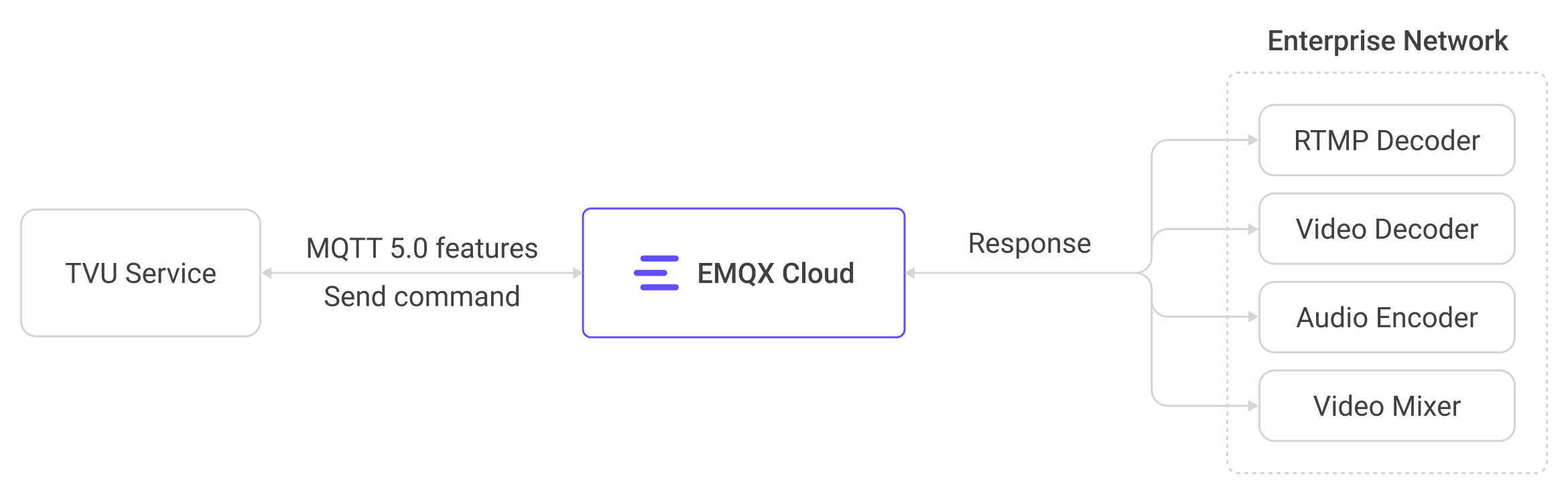
TVU services send commands to devices inside the enterprise network through EMQX Cloud, using MQTT 5.0 features, and receive responses back over the same path.
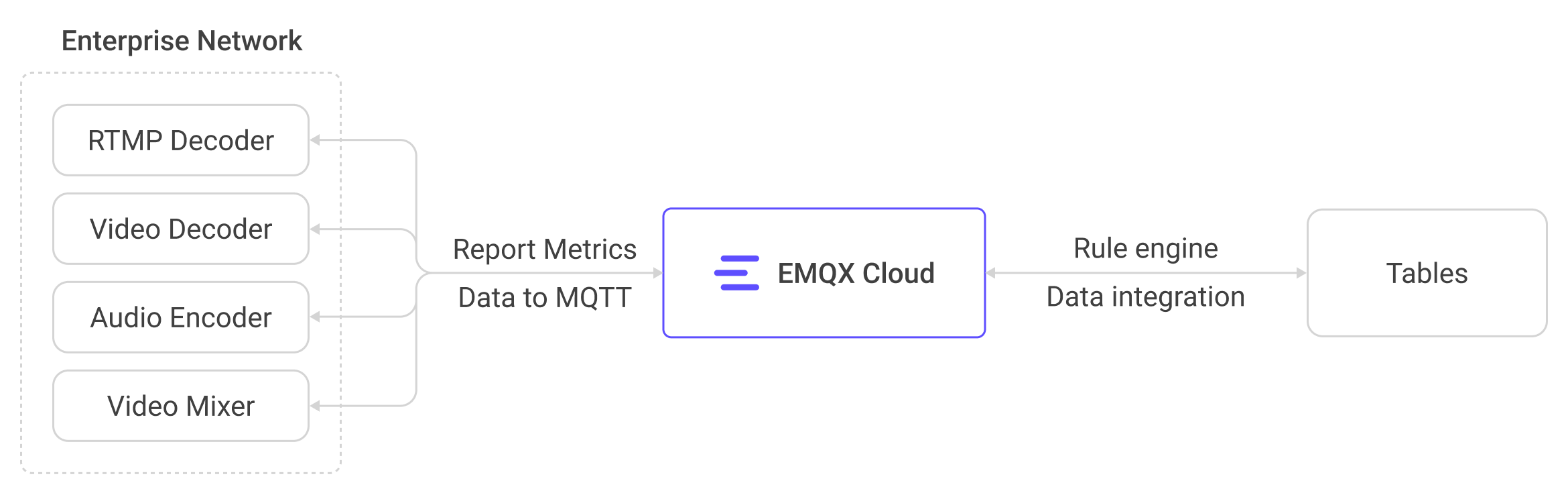
MediaHub components — RTMP decoder, video decoder, audio encoder, video mixer — report metrics to MQTT topics on EMQX Cloud, where the rule engine and data integration route them into Tables.
Under the hood: the technology powering EMQX Tables
EMQX Tables is the managed time-series layer inside EMQX Cloud, and GreptimeDB is the engine behind it. GreptimeDB provides five capabilities that shape what EMQX Tables can do.
Ingestion over InfluxDB line protocol. GreptimeDB accepts InfluxDB line protocol natively, so monitoring tools that already emit it can write without a translation layer in between.
Automatic schema creation. In the GreptimeDB–EMQX integration, tables and columns are created from incoming MQTT payloads, so ingestion can start without defining a schema up front. New message types can be persisted without a schema migration first.
High-cardinality workloads. In MQTT deployments, the number of distinct time series grows with the device fleet and multiplies with tag combinations. GreptimeDB is designed for this shape of data: a native multi-value data model over a columnar storage engine, built to hold millions of unique time series as cardinality grows.
Hot and historical data in one place. Columnar compression and object storage integration keep recent and long-retention data behind the same query surface, so a question that spans both does not mean querying two systems.
SQL, PromQL, and wire protocol compatibility. SQL covers complex analysis and PromQL covers Prometheus-style metric queries. PostgreSQL and MySQL wire protocol support means Grafana, Metabase, and DBeaver connect without an adapter.
For teams wiring this up themselves, GreptimeDB is available as a native data sink in EMQX: configure the connector in the Rule Engine or as a data bridge, select the MQTT topics to persist, and data starts flowing. There is no ETL pipeline in between.
The results: days of coordination, replaced by topic design
Routing and distributing metrics across services used to require days of cross-team coordination and implementation. Afterward, the remaining work was topic design and business logic.
"Previously, routing and distributing metrics across services could take days of coordination and implementation work. Now, teams can focus primarily on topic design and business logic, which greatly improves development efficiency and reduces operational complexity."
— Henry Chen, Software Engineering Manager, TVU Networks
Key outcomes:
- Faster service integration. Integrating new video codecs and service modules became significantly faster. New components connect over standard MQTT topics, without the complex backend coordination or networking changes the old approach required.
- Simplified monitoring. Backend services independently subscribe to the topics they care about. Distributing metrics to the teams that need them, which previously required multi-team coordination, is now largely a matter of subscribing to the right topics.
- Reduced operational complexity. The unified MQTT messaging model eliminated custom networking configuration each time the platform evolved, freeing the team to focus on product development.
Looking ahead: from cloud workflows to global hardware
MediaHub is focused on cloud-based media workflows today. If the operational results continue to hold, TVU plans to extend MQTT adoption into its broader hardware device ecosystem, which carries a large global footprint. The team sees EMQX Cloud as a long-term infrastructure partner as that expansion unfolds.
"A stable, flexible, and cost-effective platform for building scalable real-time messaging infrastructure."
— Henry Chen, Software Engineering Manager, TVU Networks, on recommending EMQX to peers
TVU's stated targets for the next 24 months, which are forward-looking rather than current deployment figures:
- 5,000+ connected clients
- 800K+ daily messages
- Expanding from North America and Europe to a broader global footprint
Building something similar
MQTT deployments tend to converge on the same requirement: telemetry that has to be stored, queried, and retained, without a separate pipeline in front of it. EMQX Tables covers that on EMQX Cloud, with GreptimeDB doing the storage and query work underneath.
If you are running MQTT workloads and want the telemetry queryable in SQL without an ETL step in between, see the GreptimeDB + EMQX solution, or get started with EMQX Cloud.
This story was originally published by EMQ as Behind the Broadcast: How TVU Networks Built Real-Time Intelligence Into Its Media Cloud. Adapted and republished here with a focus on the time-series layer. Figures 1 and 2 are reproduced unmodified from the original EMQ article. The additional technical discussion of GreptimeDB reflects Greptime's product capabilities and is not intended to represent additional claims or endorsements by TVU Networks beyond the original EMQ customer story.


